
Opportunity snapshot
Watch 5 fresh players experience your first 30 minutes. Get the 5 fixes that matter most.
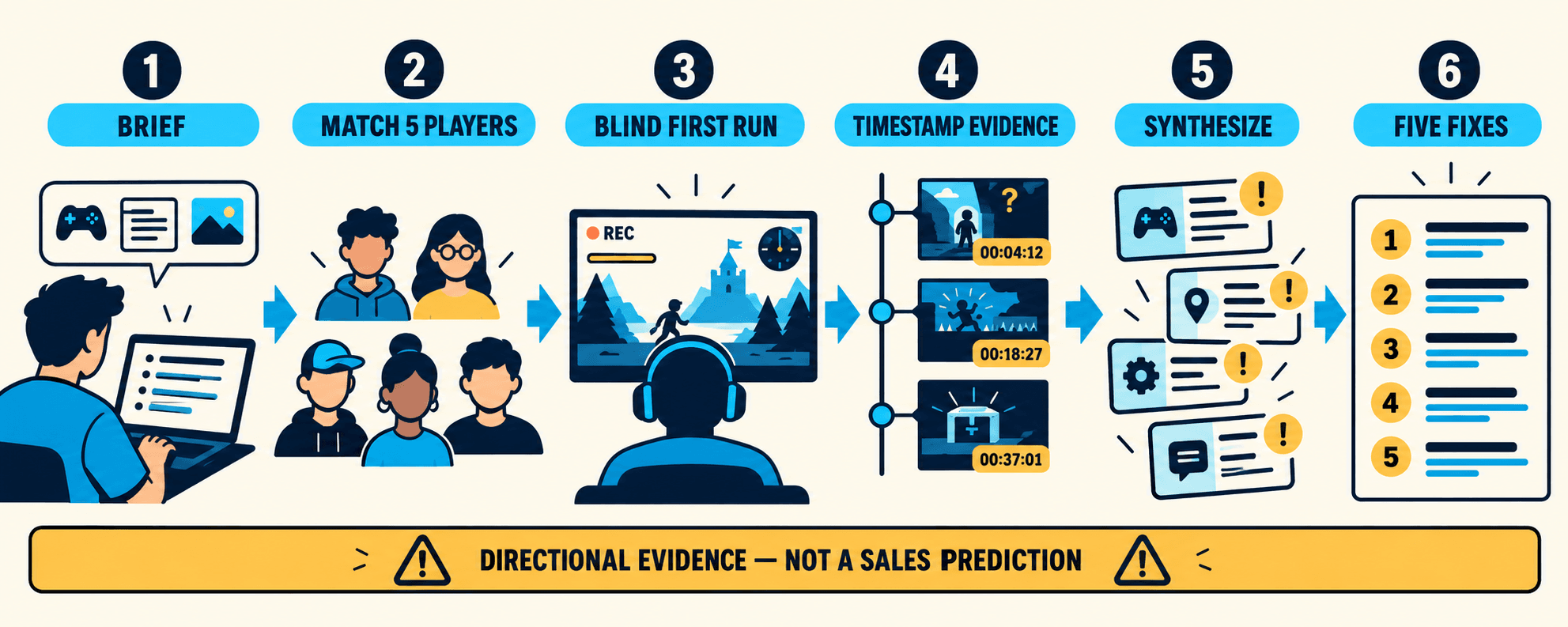
FirstRun is a fixed-scope service for solo developers and small studios preparing a Steam demo, festival build or launch. Five genre-matched players record their first 30–45 minutes while thinking aloud. FirstRun returns the raw recordings, timestamped friction points, a cross-player pattern map and a short ranked fix list.
| Opportunity score | 71/100 |
|---|---|
| Research confidence | 86/100 |
| Primary customer | Solo and 2–10 person PC-game teams with a playable Steam demo |
| Initial offer | Concierge research service, not a marketplace |
| Test price | £49 one-player audit; £149 five-player synthesis; £199 with one retest |
Executive summary
Indie developers can distribute builds through Steam Playtest, recruit in Discord, swap tests with other developers or buy individual gigs. Their harder problem is obtaining feedback from the right fresh players and converting several recordings and comments into a short list of design decisions before a demo deadline.
FACT: current products already cover most infrastructure. Viewport charges 15% on tester payouts and captures screen, microphone, input overlay and transcripts. Antidote starts recruited tests at $25 per player, lists a five-player 30-minute configuration at $182, and offers a free indie programme. PlaytestCloud sells professional subscriptions from €1,025–€1,130 per month and offers an Indie Pass. Steam Playtest itself is free distribution infrastructure.
SIGNAL: developers repeatedly report difficulty recruiting representative testers, receiving vague feedback and interpreting what to change. Academic studies also identify limited participant access, bias and scarce time as constraints for indie teams.
ASSUMPTION: a narrow segment will pay £149 for five matched first-session recordings plus expert synthesis, even when cheaper tooling and individual testers exist.
SCENARIO: at £149, £50 of tester rewards, roughly £10 of payment/storage/transcription cost and three hours of researcher labour leave £89 before labour. At £20/hour founder labour, contribution is about £29. The service fails if synthesis routinely takes more than three hours or customers value only raw videos.
The customer and problem
The initial customer is a solo developer or small PC studio with a Steam page and a playable 20–60 minute demo, usually four to eight weeks before Steam Next Fest, a publisher pitch or public launch. The team needs to answer one focused question: where does a first-time target player become confused, bored or blocked?
Friends know too much and are often too kind. Other developers notice implementation details that ordinary players miss. Open calls attract whoever is available rather than the intended genre audience. Surveys produce opinions without showing what happened immediately beforehand. Raw recordings are valuable but slow to review one by one.
Twenty-five-candidate discovery screen
The six IdeasAI inputs were treated only as signals and compared with independently found complaints, paid substitutes and manual workflows.
| Candidate | Category | Score | Decision | Adversarial finding |
|---|---|---|---|---|
| FirstRun structured Steam-demo playtest report | Productized digital service | 71 | Selected | Strong pain and spend; must beat cheap platforms on synthesis |
| Family recipe archive concierge | Consumer/digital product | 63 | Hold | Emotional value, but Trivet, Morsel, ReciScan and many scanners already exist |
| Hybrid-event audio rescue roster | Marketplace/service | 62 | Hold | Audio failure is costly; local AV companies already bundle technicians |
| Global street-food pantry kits | Ecommerce | 55 | Kill | Inventory, food compliance, spoilage and meal-kit acquisition costs |
| Coworking off-peak desk pricing adviser | Prosumer tool | 52 | Kill | Operators warn dynamic pricing creates distrust; crowded management software |
| Commercial-kitchen downtime exchange | Marketplace | 58 | Kill | Acute pain, but exact marketplace Gubbin now exists and local liquidity is hard |
| Steam-demo first-five-minutes benchmark database | Data product | 66 | Hold | Interesting data moat, but needs service volume before credible benchmarks |
| Indie-game accessibility playtest panel | Marketplace/service | 65 | Hold | Specific value, but expert recruitment and safeguarding are harder |
| Creator sponsorship brief quality audit | Creator service | 61 | Hold | Money-linked, but agencies and creator CRMs occupy the workflow |
| Short-form video disclosure checker | Creator utility | 57 | Kill | Regulatory workflow excluded and platform rules change rapidly |
| Used musical-instrument condition evidence pack | Prosumer resale | 64 | Hold | High-value transactions; expertise and local inspection constrain scale |
| Board-game prototype blind-test service | Creator service | 65 | Hold | Real need, but shipping and Tabletop Simulator add friction |
| Online-course “confusing lesson” learner panel | Education service | 64 | Hold | Clear analogue to playtesting; course creators have weaker launch economics |
| Homeschool curriculum compatibility matrix | Education data | 61 | Hold | Repeated comparison need; fragmented standards and affiliate bias |
| Family travel room-layout verification | Travel data | 64 | Hold | Expensive mistake, but exact directories and free agents are strong |
| Airline sports-equipment fee alert | Travel data | 60 | Hold | High-intent but maintenance-heavy and episodic |
| Accessible-room measurement evidence service | Travel data | 63 | Hold | High value; costly verification and liability |
| Creator digital-product refund reason synthesis | Ecommerce data | 62 | Hold | Useful, but platforms already expose exports and AI summarization |
| Second-hand sewing-machine compatibility directory | Ecommerce directory | 61 | Hold | Fragmented model data; low transaction frequency |
| Marketplace listing photo audit for vintage sellers | Ecommerce service | 59 | Kill | ChatGPT and existing listing tools are sufficient substitutes |
| Craft-market product-line profitability review | Prosumer service | 60 | Hold | Money-linked; spreadsheets and accountants remain adequate |
| Podcast guest research dossier | Creator service | 58 | Kill | General AI substitutes are too strong |
| Indie newsletter sponsorship rate benchmark | Creator data | 63 | Hold | Information asymmetry, but voluntary data collection is difficult |
| Local hobby-class cancellation marketplace | Marketplace | 56 | Kill | Two-sided local liquidity and low basket size |
| Apartment move-in defect evidence pack | Consumer utility | 62 | Hold | Expensive disputes, but episodic use and established inspection apps |
Serious-candidate pressure test
| Question | FirstRun | Recipe archive concierge | Hybrid-audio roster |
|---|---|---|---|
| Specific buyer | Solo/2–10 person Steam demo team | Family custodian with 50–300 inherited cards | Small conference organiser without AV staff |
| Pain/frequency | Every milestone; launch-risk decision | One-off preservation project | Every hybrid event; catastrophic when wrong |
| Current workaround | Friends, Discord, Reddit, Steam Playtest, Forms, raw recordings | Scanning, manual entry, recipe apps, photo services | Venue AV, freelance technicians, production firms |
| Existing spend | $25+ per recruited player; $115/month tools; four-figure platforms | $39/hour scanning; paid apps and printed books | Hybrid-audio feeds and staffed production packages |
| Closest competitors | Viewport, Antidote, PlaytestCloud, GameTester, Userplay, FirstLook | Trivet, Morsel, ReciScan, Family Recipe Box | Local AV firms and freelancer marketplaces |
| Credible wedge | Fixed first-session question, matched players, human cross-session synthesis | White-glove archive plus printed family edition | Audio-only specialist dispatch with preflight |
| Why not ChatGPT? | Cannot recruit players or observe genuine first-use behaviour | Can transcribe photos but cannot safely handle originals or verify handwriting at scale | Cannot operate live audio equipment |
| First 10 | Upcoming Steam demos, itch.io forums, gamedev Discords | Genealogy/family-history groups | Event planners and coworking venues |
| Kill | No two £149 sales from 30 qualified demos | Customers choose self-serve apps below £50 | Venue AV captures every qualified lead |
Evidence and demand signals
- FACT: Steam Playtest provides free build distribution and sign-up management. It does not recruit a representative panel or synthesize design recommendations.
- SIGNAL: recent developers describe friends being too positive, public recruitment producing little interaction, Steam feedback being difficult to obtain and comments being too vague to translate into changes.
- FACT: a 2024 CHI PLAY study of indie developers documented time/resource constraints, limited participant access and representativeness problems.
- FACT: developers already buy testing. Antidote starts at $25 per recruited player; its public calculator showed $182 for five 30-minute players. A current itch.io seller advertises two hours plus recording for $25, while another offers three players and a combined report for $39.
- SIGNAL: the low-priced service listings prove supply and some demand but also warn that a generic report is easily commoditized.
Current workflow
- Prepare a Steam Playtest or demo build and distribute keys.
- Post in Discord, Reddit, itch.io, social media or an existing mailing list.
- Screen volunteers informally, often by genre claims alone.
- Send instructions, NDA if needed and a Google Form.
- Ask testers to record or join a Discord call.
- Watch recordings, read survey responses and copy issues into a spreadsheet or tracker.
- Debate whether a comment is a one-off preference or a repeated usability problem.
- Choose changes before the next build, frequently without a retest.
Competitors and pricing
| Provider/substitute | Current offer | Published price signal | What it already does well |
|---|---|---|---|
| Viewport | Paid tester marketplace, video, mic, input overlay, transcript | 15% on tester payouts; no subscription | Almost the entire technical workflow at indie-friendly cost |
| Antidote | Targeted panel, recordings, surveys, AI insights and research services | From $25/player; $115/game/month BYO; public five-player example $182 | Recruitment, secure distribution and analysis in one platform |
| PlaytestCloud | Recruitment, video, surveys, automated analysis and research support | Professional from €1,025–€1,130/month, annually; indie programme available | Mature operations, targeting and trustworthy recordings |
| GameTester | Large tester panel, survey feedback and activity tracking | Claims about $4 average cost per tester; free account credit | Scale and low tester cost |
| PlayProbe | Link-based sessions, surveys, recording and optional telemetry | Free: one game, three tests, 20 sessions per test | Excellent free substitute when the developer supplies players |
| FirstLook | Playtest recruitment, surveys, Discord/in-game workflows, analytics | Free entry; paid indie bundle | Community and creator ecosystem |
| Steam Playtest + Discord + Forms | Free distribution, community recruitment and survey collection | Free except rewards and founder time | Native, familiar and sufficient for teams with an audience |
| Freelancers on itch.io/Reddit | Individual recordings, QA and written feedback | Examples at $25 for two hours and $39 for three-player pilot | Cheap, flexible and personal |
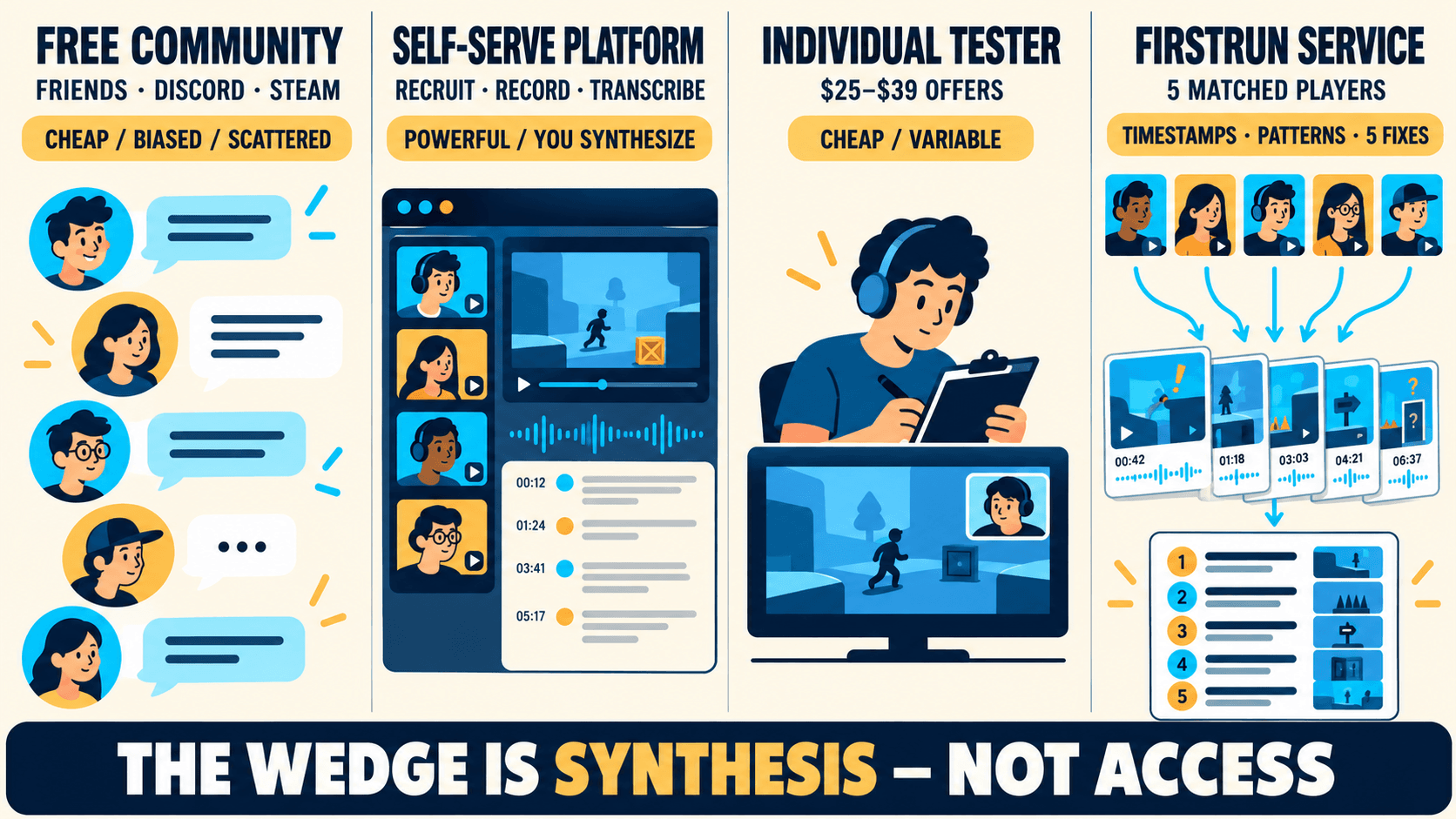
The actual market gap
Do not build a tester marketplace, recorder, survey builder or generic AI summary tool. Those are already available, often free.
The proposed wedge is a productized research decision:
- one explicit question: “What breaks the first-time-player experience in the opening 30 minutes?”;
- five players matched by genre habits and explicitly screened for whether they have seen the game before;
- independent first-run recordings with think-aloud narration;
- timestamped evidence, separated into blocker, friction, confusion, delight and preference;
- cross-player pattern map showing frequency without pretending five people are statistically representative;
- ranked top-five fixes by severity, recurrence and likely effort;
- one 30-minute developer readout;
- optional retest of the changed build with three fresh players.
Offer and pricing
Solo first-look — £49
One matched player, one 30–45 minute recording, timestamped observation sheet and three most important frictions. This is the low-risk entry offer, not the core margin product.
First Five — £149
Five matched players, recordings and consent, one standardized question set, cross-session pattern map, top-five fix brief and 30-minute readout.
Fix-and-retest — £199
First Five plus three fresh-player sessions on one revised build within 21 days and a concise before/after note.
ASSUMPTION: the buyer values synthesis and decision speed enough to pay above raw tester rewards. Do not discount below the cost of fair tester compensation.
MVP
Build now
- One-page offer with eligibility, scope, sample anonymized deliverable and booking form.
- Manual screener capturing platform, language, genre hours, comparable games and conflicts.
- Consent/NDA template and secure Steam-key handling.
- Standard recording instructions and technical preflight.
- Research brief with one primary question and up to three secondary prompts.
- Timestamped observation template and cross-session synthesis rubric.
- Private delivery folder, PDF decision brief and readout booking link.
- Outcome survey asking which fixes were accepted, rejected and shipped.
DON’T BUILD YET
- A two-sided tester marketplace.
- A custom screen recorder or game launcher.
- Automated gameplay bots or computer-vision QA.
- SDK telemetry, heatmaps or engine plugins.
- AI-only recommendations.
- Subscriptions, tester wallets, complex matching algorithms or native apps.
- Multiplayer, children’s research, console testing or biometric testing.
- Claims that five sessions predict sales, retention or market size.
User journey
- The developer submits the Steam page, build access, target player and one decision question.
- FirstRun checks scope, safety and whether a 30-minute first-session study can answer the question.
- The developer pays and approves the brief.
- Five eligible, compensated players accept consent terms and complete a technical check.
- Each player records a blind first session and short post-session survey.
- The researcher tags timestamped observations and separates observed behaviour from tester opinion.
- The developer receives recordings, evidence table, pattern map and five prioritized changes.
- A readout resolves questions without turning findings into design commands.
- The developer optionally buys a fresh-player retest after shipping changes.
Technical architecture
The validation MVP can use a server-rendered TypeScript application, PostgreSQL, encrypted object storage and Stripe Checkout, but the first ten projects should rely on proven recording tools rather than custom capture software. Core entities are studios, projects, builds, research_briefs, player_profiles, screeners, study_sessions, consents, access_keys, recordings, transcripts, observations, evidence_clips, findings, recommendations, report_versions, payments and audit_events.
Every finding must link to one or more timestamped observations. Recordings remain private, access expires, Steam keys are encrypted and single-use where possible, and tester identity is hidden from the developer unless explicitly required and consented.
Economics
SCENARIO: a £149 First Five package allocates £10 per tester (£50), £7 payment processing, £3 storage/transcription and £60 for three hours of founder synthesis at £20/hour. That leaves £29 contribution before acquisition, failed sessions and support. At four hours of synthesis the package is effectively break-even.
Margins improve through a disciplined template, repeat studies, raising price to £179–£249, and selling to funded micro-studios rather than hobbyists. They do not improve by underpaying testers. A sustainable service should target at least 45% contribution margin before founder salary after the first ten studies.
First 10 customers
- Build a list of 100 PC games with public Steam pages and demos launching or joining a festival within 4–8 weeks.
- Send 30 highly specific messages referencing the game genre and offering a paid, fixed-scope first-session study—not “free feedback.”
- Post an anonymized sample report in itch.io’s help-wanted/offered area and relevant gamedev Discords where promotion is permitted.
- Partner with two indie-game marketing consultants, trailer editors or Steam-page reviewers who encounter playable demos.
- Offer three £49 single-player audits as risk-reversal, then credit the fee toward First Five.
- Ask every completed customer to introduce one other developer preparing a demo.
SEO and distribution
High-intent pages include “indie game playtesting service,” “Steam demo playtesters,” “how to get useful feedback on a Steam demo,” “Steam Next Fest playtest checklist” and “game playtesting service price.” Search is useful but communities and partner referrals should produce the first customers faster.
Publish real research artefacts: an anonymized first-session report, a rubric for vague versus actionable feedback, a calculator comparing five raw videos with a synthesized study, and a teardown showing how repeated friction differs from individual preference. Do not seed fake community questions or promise wishlists and sales.
Risks
- Viewport and similar products already make recruitment and recording extremely cheap.
- A $39 three-player aggregated-report offer demonstrates direct price competition.
- Hobby developers may have no budget; funded studios may prefer experienced researchers.
- Five players are directional, not statistically representative.
- Poor genre matching makes findings actively misleading.
- Malware concerns, unreleased-build leakage and Steam-key handling create trust work.
- Tester no-shows and unusable recordings erode margins.
- Researcher recommendations can overreach into subjective game design.
- AI summaries may commoditize basic synthesis, though they cannot repair biased recruitment.
Moat and expansion
There is no initial software moat. Potential defensibility comes from trusted genre-specific player panels, repeatable research quality, a corpus of consented and anonymized first-session patterns, demonstrated turnaround and partner referrals. Raw game builds and identifiable recordings must never become shared training data.
Only after ten paid projects should expansion include genre-specific benchmark reports, recurring milestone studies, store-page-to-demo continuity tests, accessibility panels or a self-serve workflow that lets studios bring their own players.
Kill criteria and seven-day validation
- Day 1: create an anonymized sample report from one publicly available demo and five synthetic placeholder session summaries; label the sample clearly.
- Day 2: interview five developers who ran a playtest in the previous six months. Ask what they paid, what they reviewed and what changed.
- Day 3: identify 30 qualified Steam demos with a visible release/festival deadline and send personalized offers.
- Day 4: sell a £49 one-player audit or £149 First Five package. Do not offer the full study free.
- Day 5: recruit and compensate players manually; use existing screen-recording tools.
- Day 6: deliver the first report and measure preparation, review and synthesis time.
- Day 7: ask for a paid retest deposit and one referral; document which proposed fixes the developer accepts.
Pass: 10 developer conversations, at least two paid First Five studies at £149 or one £149 study plus three £49 audits, at least 60% of reported priority findings accepted as useful, delivery within 72 hours, no more than three researcher hours per First Five report, and one paid retest or referral.
Kill: no two £149-equivalent sales after 30 qualified personalized offers; customers want only cheap raw recordings; fewer than half of priority findings are considered useful; tester acquisition exceeds £15 per accepted session; synthesis takes more than four hours; or security concerns prevent access to usable builds.
Founder fit
Best suited to someone with games-user-research, UX research, game design or structured qualitative-analysis experience who enjoys service delivery before software. Poor fit for a general developer who assumes a transcript summary is research, cannot recruit representative players or wants to automate judgment immediately.
Final score
| Factor | Score | Reason |
|---|---|---|
| Pain | 16/20 | First-session confusion can waste a critical public demo opportunity |
| Willingness to pay | 15/20 | Clear platform, tester and research-service spend |
| Competition gap | 7/15 | Many exact tools and cheap services; synthesis wedge is narrow |
| MVP feasibility | 14/15 | Manual service can sell and deliver immediately |
| Recurring revenue | 6/10 | Studios test multiple milestones, but individual projects are episodic |
| Acquisition | 7/10 | Public Steam pages, festivals and partner channels expose intent |
| SEO | 3/5 | Useful intent, but established platforms dominate broad terms |
| AI advantage | 3/5 | Transcription and evidence clustering help; human research judgment remains core |
Total: 71/100. Research confidence: 86/100. Verdict: 🟢 VALIDATE.
🛠 FREE AI BUILD PROMPT
You are a senior product engineer, games user researcher, privacy engineer and service designer. Build the smallest validation-first operations system for FirstRun, a productized first-session playtesting service for small PC game studios.

PRODUCT PRINCIPLE
FirstRun is not a tester marketplace, automated QA product or sales predictor. It helps a researcher recruit a small, relevant set of fresh players, collect consented think-aloud recordings, link findings to timestamped evidence and deliver a conservative prioritized decision brief. Five sessions are directional qualitative evidence, never statistical proof.

PRD
Customer: solo developer or 2–10 person studio with a playable Steam demo and one focused first-session research question.
Core job: identify repeated blockers, confusion, friction and delight in the first 30–45 minutes before a demo deadline.
Success: deliver accepted recordings and an evidence-linked report within 72 hours while keeping researcher synthesis under three hours.

USER STORIES
1. A developer can submit a Steam page/build, target-player definition, deadline and one primary question.
2. An operator can accept, reject or narrow the study scope before payment.
3. A tester can complete a screener, consent, NDA and technical preflight.
4. An operator can assign eligible testers without exposing unnecessary personal data.
5. A tester can receive time-limited build instructions and upload or link a recording securely.
6. A researcher can add timestamped observations and classify them as blocker, friction, confusion, delight or preference.
7. A researcher can group observations into findings without losing source links.
8. A developer can view findings, play evidence clips and mark actions accepted, rejected or deferred.
9. A corrected report creates a new version and preserves the original.
10. A customer can request a fresh-player retest of one revised build.

MVP SCOPE
Build project intake, manual qualification, payment, tester screener, assignment, consent, secure key handoff, recording metadata/upload links, observation tagging, finding synthesis, private report, PDF export, readout scheduling and outcome feedback. Integrate proven recording tools; do not build screen capture.

SCREENS
1. Public landing page with scope, sample deliverable, pricing and limitations.
2. Study application.
3. Operator qualification and quote screen.
4. Stripe Checkout status.
5. Developer brief wizard.
6. Tester profile, screener and conflicts declaration.
7. Consent/NDA and technical preflight.
8. Assignment and time-limited build-access screen.
9. Session submission with recording link/upload, duration and post-session survey.
10. Research workspace with synchronized video/transcript timestamp.
11. Observation board and cross-session pattern matrix.
12. Finding editor with severity, recurrence, confidence and evidence links.
13. Developer report with clips and action response.
14. Report version history.
15. Retest booking.
16. Admin views for projects, testers, failed sessions, payments, deletion and audit events.

USER FLOWS
Developer applies → operator checks fit → quote → payment → approved brief → tester screening and assignment → consent/preflight → session capture with existing tool → secure submission → researcher observations → evidence-linked synthesis → private delivery/PDF → readout → developer action feedback → optional retest.

DATABASE
Use PostgreSQL with studios, users, memberships, projects, builds, study_applications, quotes, research_briefs, player_profiles, genre_experience, screeners, screener_answers, conflicts, study_sessions, assignments, consents, nda_acceptances, access_keys, preflight_checks, recording_assets, transcripts, survey_responses, observations, evidence_clips, findings, finding_observations, recommendations, report_versions, developer_actions, payments, refunds, tester_rewards, deletion_requests and audit_events.

Store build keys encrypted and never log them. Use UUID/ULID public identifiers. Every finding must reference at least one observation; every observation must reference a session and timestamp. Preserve report history.

ARCHITECTURE
Use TypeScript and a server-rendered web framework, PostgreSQL, encrypted S3-compatible object storage, background jobs for media processing/email/PDF, Stripe Checkout and a provider-neutral transcription adapter. Provide Docker local development, schema migrations and synthetic fixtures. Use managed authentication with mandatory MFA for operators and researchers. Customers and testers use passkeys or magic links.

INTEGRATIONS
MVP may integrate Stripe Checkout, transactional email, object storage, a calendar link and one transcription provider. Accept private cloud recording links or direct upload. Steam keys are entered by the developer and revealed once to an assigned tester where practical. Do not claim a Steam API can distribute unreleased builds automatically. Do not reverse engineer Steam or capture gameplay through a custom SDK.

UI/UX
Visual design should feel like a calm research instrument, not a gamer social network. Use high-contrast neutral surfaces, one cyan accent, clear study status, visible deadlines and semantic severity labels. Make evidence clips keyboard accessible, transcripts searchable and reports printable. Meet WCAG 2.2 AA.

RESEARCH MODEL
Separate observed behaviour from tester opinion and researcher interpretation. Observation categories: blocker, friction, confusion, delight, preference. Finding fields: statement, severity, sessions_affected, confidence, evidence_links, affected_moment, possible_explanations, recommendation and limitation. Never present frequency from five sessions as a population percentage.

AI BOUNDARY
AI may transcribe recordings, suggest timestamps, cluster semantically similar observations, detect missing evidence and draft plain-language finding summaries. A human researcher must confirm every timestamp, classification, finding and recommendation. AI must not invent behaviour, score game quality, predict commercial success, infer protected traits, decide tester eligibility from sensitive data or convert a player preference into a defect automatically.

PAYMENTS
Use one-time Stripe Checkout for £49, £149 and £199 offers. Track gross amount, tax, refund, tester reward, processing cost and project contribution. During validation pay testers outside the app through a documented manual process; do not build a wallet or hold balances. Never delay deletion or consent withdrawal because of payment state.

ANALYTICS
Track application_started, application_submitted, quote_sent, checkout_completed, brief_approved, tester_invited, consent_completed, session_started, session_submitted, session_accepted, observation_created, finding_published, report_viewed, evidence_played, action_recorded, readout_completed and retest_purchased. Never send builds, keys, video, transcript text, game names under NDA or tester identity to third-party analytics.

PRIVACY AND SECURITY
Apply least privilege, tenant isolation, encryption in transit/at rest, short-lived signed media URLs, malware scanning, MIME validation, rate limits, CSRF protection, secure headers, secrets management and immutable audit logs. Strip unnecessary metadata. Define retention separately for builds, keys, recordings, transcripts and research reports. Support consent withdrawal and deletion, subject to minimal accounting records. Do not use recordings or builds to train shared models without explicit opt-in. Show download/view audit history to operators.

SAFETY AND QUALITY
Reject executable uploads when a safer Steam build/key path exists. If direct builds are accepted later, quarantine and scan them; do not execute on the server. Add processes for tester no-shows, unusable audio, prior exposure to the game, leaked keys, conflicts of interest, harassment, under-18 applicants and disputed findings. MVP supports adults only, single-player PC demos and English-language sessions.

TESTING
Unit test permissions, tenant isolation, key encryption, consent states, assignment eligibility, timestamp bounds, finding-evidence requirements, report versioning, price calculations and retention. Integration test Stripe webhooks, email, signed URLs, uploads, transcription, PDF export and deletion. Security-test IDOR, enumeration, XSS, CSRF, malicious files, replayed webhooks and cross-tenant media access. End-to-end test application through developer action feedback using synthetic projects and recordings. Run accessibility checks on all customer/tester flows.

DEPLOYMENT
Deploy to a managed platform with PostgreSQL, private object storage, background workers, secret management, staging, health checks, structured logs, backups and restore tests. Choose a UK/EU region deliberately and document subprocessors. Prepare incident-response and build-leak runbooks before accepting unreleased games.

ACCEPTANCE CRITERIA
- A qualified developer can pay and approve a focused brief.
- Operators can recruit five eligible adults and record conflicts.
- Build credentials never appear in logs or analytics.
- Each accepted session has consent, preflight and a usable recording.
- Every published finding links to timestamped session evidence.
- Reports distinguish behaviour, opinion and researcher interpretation.
- Five-session frequency is never described as statistically representative.
- Developers can play clips, export PDF and record action decisions.
- Corrections preserve prior report versions.
- Retention expiry and deletion are auditable.
- The service can be delivered without custom capture software.

DO NOT BUILD YET
Tester marketplace, tester wallet, custom recorder/launcher, automated gameplay bots, Unity/Unreal SDKs, telemetry heatmaps, console/mobile support, multiplayer orchestration, children’s research, biometric testing, public game profiles, subscriptions, complex matching algorithms, AI-only reports, sales predictions or benchmark claims.

DELIVERY ORDER
First produce a service blueprint, threat model, consent/retention matrix, research taxonomy, database schema, sample report and manual operating procedure. Then build one vertical slice: application, qualification, one-time payment, five manual assignments, consent, secure recording submission, timestamped observations, evidence-linked report and developer action feedback. Complete ten paid studies before considering marketplace infrastructure.
Social package
Facebook — plain text
🎮 IDEA #006/100 — FIRSTRUN
Indie developers can find playtesters.
The harder problem is turning five recordings and a pile of “felt good” comments into the five fixes that matter before a Steam demo goes public.
FirstRun is not another tester marketplace. It is a fixed-price first-session study: matched players, recordings, timestamped friction and one human-synthesized decision brief.
Score: 71/100
Research confidence: 86/100
Verdict: Validate
The uncomfortable question: will developers pay £149 for synthesis when cheap platforms already provide recordings?
CYBERTRICKZ 100
100 DAYS • 100 IDEAS • 100 BUILD PROMPTS
Research it. Validate it. Build it.
Idea #006/100: FirstRun.
Steam Playtest, Discord and new indie-focused platforms make it easier than ever to distribute a build and capture feedback. That means “access to testers” is no longer a sufficient business.
The remaining wedge may be narrower: five genre-matched players encounter a demo cold, record the first 30–45 minutes, and a human researcher turns the evidence into a timestamped pattern map and five prioritized fixes.
Score: 71/100. Research confidence: 86/100. Verdict: Validate.
The seven-day test is service-first: sell two £149 studies before building any marketplace, recorder or dashboard.
IDEA #006/100: FirstRun
Indie developers do not necessarily need another place to find testers.
They may need someone to turn five first-session recordings into five evidence-backed fixes before the Steam demo goes public.
Score: 71/100
Confidence: 86/100
Verdict: Validate
The full report includes current competitors, pricing, kill criteria and the free AI build prompt.
First comment
The full report includes the 25-candidate screen, current competitor pricing, seven-day paid-service test and implementation prompt.
Key limitation: five playtests provide directional qualitative evidence. They do not predict sales or represent the whole market.
Email edition
Subject: Idea 006/100: five players, five fixes before your Steam demo
Preview: The playtesting market is crowded. A narrow human-synthesis wedge still scores 71/100.
Finding playtesters is easier than it used to be. Steam Playtest handles distribution, Discord and Reddit offer communities, and platforms such as Viewport and Antidote can recruit players and capture recordings.
The unsolved job may be smaller: turn five cold first-session recordings into a short, evidence-linked decision brief before a public demo deadline.
FirstRun would recruit genre-matched players, record the opening 30–45 minutes and deliver timestamped friction, repeated patterns and five prioritized fixes. It would begin as a manual service, not a marketplace.
CYBERTRICKZ SCORE: 71/100
RESEARCH CONFIDENCE: 86/100
VERDICT: VALIDATE
The critical test is whether two qualified developers pay £149 despite cheap recording tools and individual testers.
READ THE FULL RESEARCH + COPY THE FREE AI BUILD PROMPT → https://cybertrickz.info/business-opportunities/firstrun-indie-steam-demo-playtesting-service/
CYBERTRICKZ 100
100 DAYS • 100 IDEAS • 100 BUILD PROMPTS
Research it. Validate it. Build it.
Sources
- Playtesting professional on poor discovery and feedback matching
- Current developer recruitment discussion
- Current vague-feedback discussion
- Current tester-recruitment complaint
- Friends being too positive and difficulty finding honest feedback
- CHI PLAY study of indie playtesting constraints
- Indie pre-release experimentation interview survey
- Viewport features and 15% pricing
- Antidote current pricing and indie programme
- PlaytestCloud current pricing
- PlaytestCloud Indie Pass details
- GameTester developer offer and price signal
- PlayProbe free tier
- FirstLook playtesting platform
- Current $25 individual testing service
- Current $39 three-player report offer
- Recipe-card digitisation complaint
- Trivet recipe-card scanning competitor
- Morsel recipe-card scanning competitor
- Gubbin hospitality downtime marketplace
Research date: 4 October 2026. Community posts and service listings are anecdotal demand signals. Competitor pricing can change. No conversion rate, market size, tester-quality rate or revenue forecast has been invented.