
Opportunity snapshot
DealProof Desk is a productized security-questionnaire response service for small B2B SaaS and AI companies pursuing their first enterprise customers. A founder uploads the buyer’s spreadsheet plus approved policies and previous answers. The service returns an evidence-grounded draft in the buyer’s original format, a private gap report, and a reusable answer library.
| Opportunity score | 68/100 |
|---|---|
| Research confidence | 84/100 |
| Primary customer | 5–30 person B2B SaaS or AI vendor with no dedicated security/compliance owner |
| Initial business | Productized, human-reviewed service |
| Suggested price | $349 standard, $699 complex, then optional $99/month answer-vault maintenance |
Executive summary
The prospect likes the product. Then procurement sends an Excel workbook containing 150 to 300 security questions. The founder, CTO and engineer lose two or three days reconstructing answers about encryption, access control, backups, subprocessors, incident response and AI data use. The questionnaire does not merely consume time. It sits directly in the path of a valuable enterprise deal.
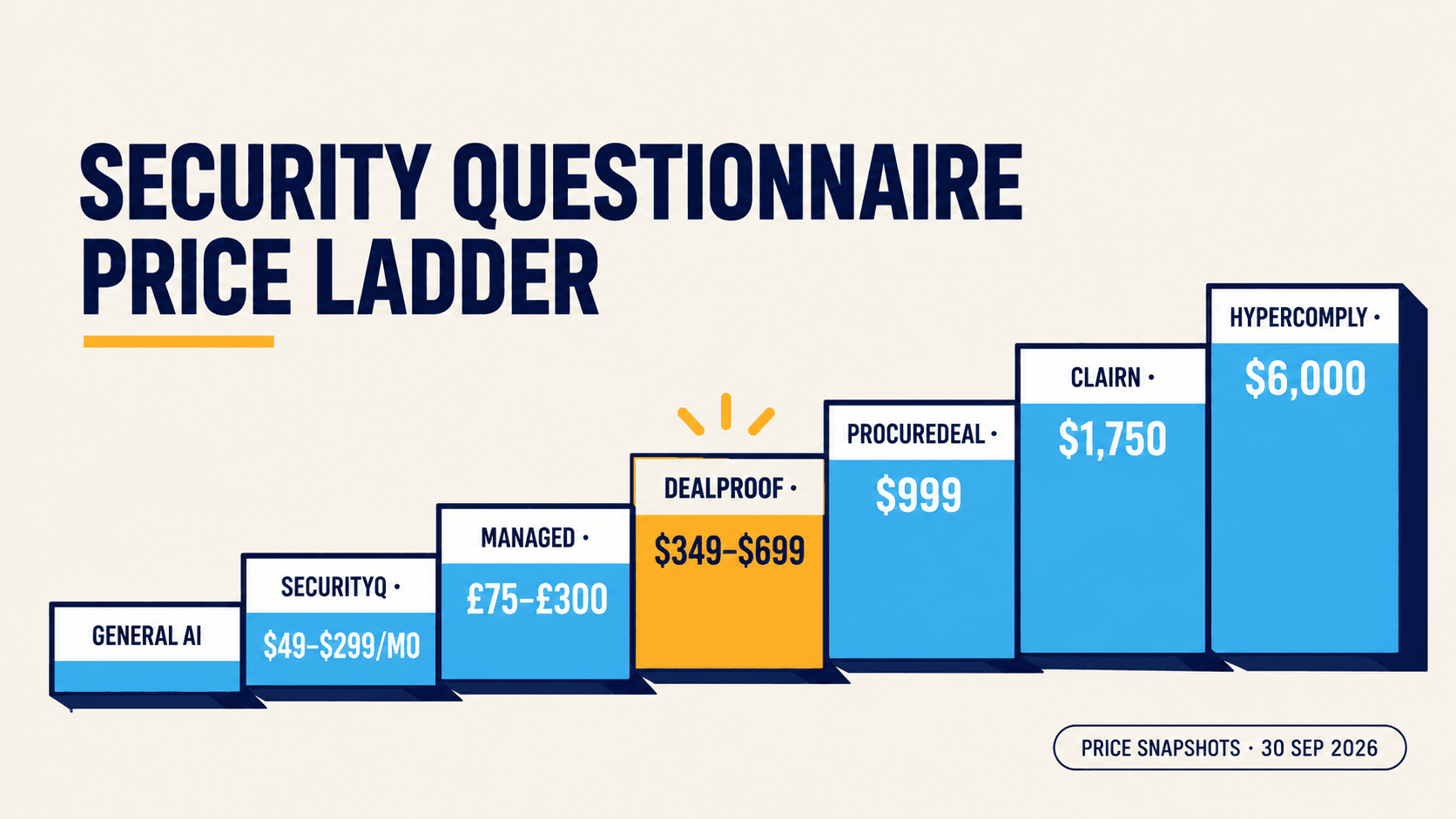
There is clear existing spend. HyperComply lists a small-business questionnaire product on AWS Marketplace at $6,000. SecurityQ advertises self-service plans from $49 to $299 per month. Managed providers publicly advertise prices from £75 for a short questionnaire to $1,750 for a complex one, while ProcureDeal offers a $999 urgent deal-rescue service.
This means the opportunity is validated and crowded. The viable entry is not another “AI fills questionnaires 10× faster” SaaS. It is a tightly scoped service for companies too early for a full compliance platform: human-reviewed responses, traceable sources, unsupported claims flagged rather than invented, original-file delivery, and a reusable evidence pack after the first engagement.
The problem
Small vendors selling into larger organisations often receive a buyer-specific security or AI-governance questionnaire late in the sales cycle. The buyer may use SIG, CAIQ or a bespoke spreadsheet or portal. The vendor’s answers are scattered across policies, architecture notes, old questionnaires and employee memory.
Signal: one 2026 SaaS discussion described 150–300 questions, two to three days of work and a fear of spending $20,000 on a broad platform. Another described six questionnaires consuming more than 40 founder hours in one quarter. These are self-selected community reports, not representative benchmarks.
Fact: paid tools and services already exist at multiple price points. That is stronger willingness-to-pay evidence than survey enthusiasm.
Assumption to test: a small vendor will pay $349–$699 for reviewed completion when an important deal is blocked, rather than use a general AI tool or a cheaper provider.
Ideal customer
The first customer is a 5–30 person B2B SaaS or AI company that:
- has a real enterprise prospect waiting;
- has received a questionnaire in Excel, Word, PDF or a buyer portal;
- has at least some policies, architecture documentation or previous answers;
- does not employ a dedicated GRC professional;
- expects only one to six questionnaires per year, making a large annual platform difficult to justify.
Do not start with heavily regulated vendors, companies requiring FedRAMP, large teams processing dozens of reviews per month, or businesses with no written security evidence. Those customers need a mature platform, consultant or fractional security leader.
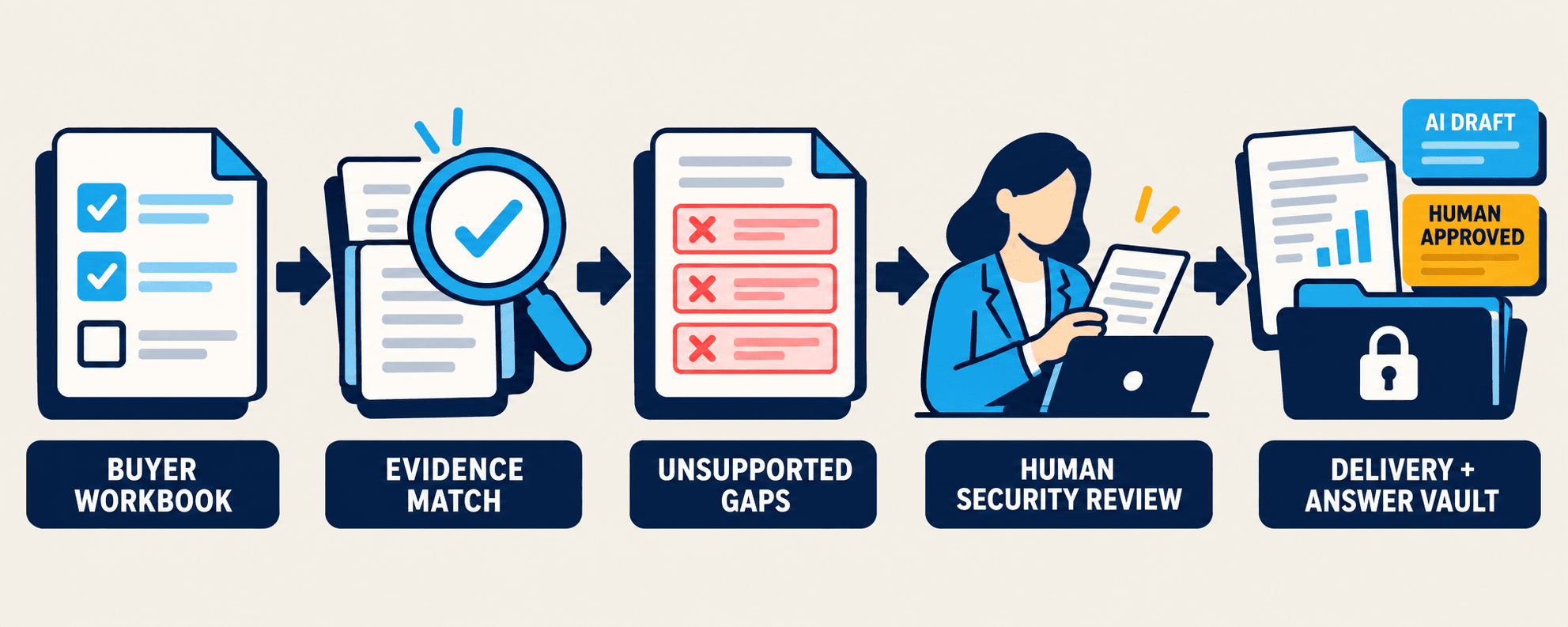
Customer workflow today
- The sales team receives the buyer’s questionnaire.
- A founder or sales engineer searches old spreadsheets and policy documents.
- Questions are assigned informally to engineering, legal or operations.
- Someone copies and adapts old answers.
- Missing evidence is discovered late.
- Answers are reformatted into the buyer’s workbook or portal.
- A senior person reviews the file, often under deadline.
- The team forgets to convert approved answers into a maintained library.
Thirty-candidate discovery screen
The round deliberately searched business models rather than software features. Preliminary scores are rapid-screen estimates; only DealProof Desk received full research.
| Candidate | Score | Decision | Main issue |
|---|---|---|---|
| Managed security-questionnaire deal desk | 68 | Selected | Strong revenue link; exact services and cheap software compress the wedge |
| SKU landed-cost and tariff change report | 66 | Hold | Acute pain, but tariff calculators and trade platforms are multiplying |
| AI vendor trust-pack service | 67 | Hold | New buyer questions, but overlaps strongly with selected opportunity |
| Shopify packaging-EPR exposure audit | 64 | Hold | Real spend; several 2026 products already target Shopify and small brands |
| Used professional-equipment maintenance passport | 62 | Hold | Could improve resale value, but payer and distribution remain unclear |
| Independent course-resource integrity monitoring | 62 | Hold | LMS-native and free link-checking substitutes |
| Shared pet-medication handoff | 64 | Hold | Strong anxiety; crowded consumer tracker market |
| Marketplace chargeback case preparation | 61 | Hold | Money-linked, but integrated chargeback platforms are stronger |
| Grant-fit brief for specialist consultancies | 60 | Hold | Fragmented sources and uncertain repeat purchase |
| Home-insurance inventory concierge | 60 | Hold | Event-driven rather than recurring |
| Campervan payload planning pack | 61 | Hold | Free calculators constrain payment |
| Short-term-rental regulation alerts | 58 | Kill | Numerous address-level alert products launched |
| Tender bid/no-bid service | 58 | Kill | Exact free and paid qualification products |
| Newsletter sponsorship operations service | 59 | Kill | Small publishers remain price-sensitive; existing tools cover workflow |
| Sensory-friendly venue data membership | 59 | Kill | Expensive data cold start and unclear payer |
| Return-deadline consumer wallet | 57 | Kill | Many free apps and email-access friction |
| Local sports substitute-player marketplace | 55 | Kill | Two-sided local liquidity problem |
| Group-trip decision concierge | 54 | Kill | Low willingness to pay |
| Recipe normalisation membership | 55 | Kill | Crowded consumer category |
| Creator sponsor-contract operations | 61 | Hold | Overlaps established creator CRMs and Idea #003 |
| Small-fleet compliance reporting service | 59 | Kill | Hardware and established platform dependency |
| Marketplace seller policy-change digest | 58 | Kill | Platforms, newsletters and communities provide free updates |
| Paid community for first-time importers | 56 | Kill | Advice liability and episodic retention |
| Local planning-permission lead feed | 61 | Hold | Promising lead economics but fragmented public data and existing providers |
| Commercial kitchen opening lead feed | 60 | Hold | Reachable buyers, but local data collection is labour intensive |
| AI-policy digest for school leaders | 55 | Kill | Institutional budgets and free official guidance |
| Micro-acquisition due-diligence checklist service | 60 | Hold | High value but trust and liability barriers |
| Private-label product recall monitor | 61 | Hold | Useful data product, but matching and regulatory coverage are difficult |
| Prosumer tool-rental marketplace | 54 | Kill | Insurance, local supply and trust make validation expensive |
| Manual cash-flow forecast review for tiny brands | 57 | Kill | Accountants and free templates are adequate substitutes |
Demand and payment evidence
- Community signal: founders report losing days to repeated questionnaires and maintaining answer spreadsheets. These reports are anecdotal and several posts were made by builders validating products.
- Software spend: HyperComply’s AWS Marketplace listing shows a $6,000 small-business tier. SecurityQ publishes $49, $149 and $299 monthly plans.
- Service spend: Security Questionnaire Response advertises £75, £150 and £300 bands. ProcureDeal offers $999 for one blocked deal. Clairn lists $1,750 for a complex questionnaire. Optimum Web lists €600 to €2,500 bands.
- Economic context: the questionnaire arrives after a buyer has shown serious interest. The fee can be evaluated against the deal rather than a general productivity budget.
- Recurring behaviour: approved answers drift as architecture, subprocessors, policies and AI providers change, creating a maintenance opportunity.
Competitor landscape
| Competitor | Offer | Published price signal | Implication |
|---|---|---|---|
| Security Questionnaire Response | Human completion, gap note, original format | £75 to £300; five-pack £950 | Direct low-cost competitor makes generic completion unattractive |
| Clairn | Done-for-you questionnaires with guarantee | Complex tier $1,750 | Shows room for higher-touch, high-stakes work |
| ProcureDeal | Evidence-grounded AI and security questionnaire completion | $999 deal rescue | Exact AI-vendor wedge already exists |
| SecurityQ | Self-service answer library, exports and trust centre | $49 to $299/month | Cheap software substitute |
| Knowally | Self-service document-grounded drafts with citations | Free entry; higher tiers vary | Another focused software entrant |
| HyperComply | Automation, trust pages and human review | AWS small-business listing $6,000 | Established platform for teams with volume |
| Conveyor | Knowledge library, portal automation and collaboration | Demo-led | Powerful incumbent serving mature teams |
| ChatGPT or another general model | Drafts answers from pasted documents | Low marginal cost | The most dangerous substitute if the company already maintains good evidence |
What competitors do well
The focused software vendors already support Excel and document imports, answer reuse, citations and exports. Managed competitors return files in the buyer’s format and explicitly flag gaps. Enterprise platforms add trust centres, portal automation and collaboration. A new entrant cannot win merely by adding retrieval-augmented generation.
The narrow wedge
Position the first offer as first enterprise deal rescue, not questionnaire automation:
- for vendors with one live, valuable deal and no compliance owner;
- fixed price confirmed after a free pre-scan;
- 48–72 hour turnaround for a standard workbook;
- every answer linked to the customer’s own policy, architecture note or approved statement;
- unsupported and contradictory answers flagged, never smoothed over;
- human security review before delivery;
- returned in the buyer’s original file;
- a reusable answer vault and missing-evidence roadmap included.
The differentiation is accountability and a useful asset after the emergency. It must be demonstrated in service quality, not claimed in marketing copy.
Offer design
Standard rescue, $349
- Up to 150 questions in Excel, Word or text PDF
- One evidence pack
- Evidence-linked draft
- Private gap report
- One clarification round
- Reusable answer library
- Three-business-day target
Complex rescue, $699
- 151–350 questions, multiple sheets or AI-governance section
- Stakeholder question list
- Two clarification rounds
- One review call
Keep-current, $99/month
- Quarterly answer/evidence review
- Subprocessor and policy-change prompts
- One small update request per month
Pricing is a test hypothesis. The £75 competitor may force a lower entry price, while security expertise and insurance may force a higher one.
MVP
The first MVP is a secure service workflow, not autonomous software.
Build now
- Landing page with free pre-scan and explicit scope
- Secure upload and deletion workflow
- Structured intake covering product, hosting, data, AI use and existing evidence
- Internal answer library with source citations and approval status
- Question classification, similarity matching and gap flags
- Human review checklist
- Original-format export
- Customer approval log
- Reusable answer-vault export
DON’T BUILD YET
- Full compliance platform
- SOC 2 or ISO certification workflow
- Automatic claims about control operation
- Buyer-portal browser automation
- Trust centre
- Real-time integrations with every wiki or drive
- Autonomous submission
- Legal advice or security attestation
Seven-day validation
- Day 1: interview five SaaS founders who received a questionnaire in the last six months.
- Day 2: build the secure intake and a redacted sample deliverable.
- Day 3: offer a free ten-question pre-scan to 30 qualified founders and fractional CISOs.
- Day 4: quote fixed prices on real files. Do not offer free full completion.
- Day 5: deliver the first paid standard questionnaire manually.
- Day 6: measure founder hours required, questions lacking evidence and review corrections.
- Day 7: test whether the customer pays for answer-vault maintenance or a second response.
Pass: ten qualified conversations, three real questionnaires submitted, two paid rescues at $349 or more, delivery gross margin above 60% before founder salary, and fewer than 10% of delivered answers materially corrected by the customer.
Fail: founders prefer ChatGPT plus their existing docs, low-cost competitors win every quote, secure handling prevents trust, or qualified human review makes delivery uneconomic.
Acquisition
- Partner with fractional CISOs, SOC 2 readiness consultants, penetration testers and SaaS lawyers who encounter blocked deals.
- Publish a free “questionnaire readiness” pre-scan and a buyer-question taxonomy.
- Search founder communities for live, non-promotional requests and offer the pre-scan privately where permitted.
- Target high-intent search terms such as security questionnaire completion service, help with vendor security questionnaire and SIG Lite questionnaire support.
- Build comparison pages around service versus automation versus general AI, without inventing competitor prices.
- Ask every customer for a referral immediately after the enterprise review clears, not months later.
Economics
This is a scenario, not observed unit economics. A standard $349 job that takes three analyst hours, half an expert-review hour and $15 of model/storage cost has thin but workable contribution margin if blended labour is controlled. If each job requires six to eight senior hours, the price must rise or the model fails.
The maintenance subscription is attractive only if customers update evidence and return for more questionnaires. Otherwise, accept that this may be a high-intent service business with episodic repeat revenue rather than SaaS.
Risks
- A wrong answer can create contractual, security or reputational exposure.
- Customers may lack the evidence required to answer honestly.
- General AI plus a well-maintained answers document may be good enough.
- Exact services already compete below and above the proposed price.
- Secure file handling, data-processing terms and professional insurance add cost.
- Portal-only questionnaires resist standard export.
- Human review can destroy margins.
- Founders may need broader security remediation, not form completion.
Kill criteria
Kill the offer if two paid rescues cannot be sold after 30 qualified conversations, if customers will not provide evidence through the proposed secure process, or if the first three deliveries require more than five expert hours each at the tested price. Kill the software roadmap if customers buy urgent completion but decline answer-vault maintenance and self-service use.
Moat and expansion
There is no initial technical moat. Potential advantages are trusted channel partners, a disciplined evidence model, fast original-format delivery and a growing customer-approved answer history. Customer documents must remain isolated and never be used to train shared models without explicit consent.
Expansion could include AI-governance addenda, buyer clarification support, proactive trust packs and referrals to fractional security professionals. A full compliance suite should be considered only after repeat volume proves the need.
Founder fit
This opportunity fits a founder with security or GRC literacy, careful written communication and comfort delivering a service before software. It is a poor fit for an inexperienced builder planning to let an LLM answer unsupervised. Credibility, confidentiality and saying “unknown” are core product capabilities.
Final score
| Factor | Score | Reason |
|---|---|---|
| Pain | 16/20 | Directly blocks enterprise revenue and consumes senior time |
| Willingness to pay | 15/20 | Multiple software and service price points prove spend |
| Competition gap | 6/15 | Exact low-cost and premium competitors |
| Ease of MVP | 14/15 | Concierge service can validate immediately |
| Recurring revenue | 6/10 | Recurring for growing vendors; episodic for early teams |
| Acquisition | 7/10 | High-intent search and strong partner channels |
| SEO | 2/5 | High intent but specialised and competitive |
| AI advantage | 2/5 | Useful matching and drafting; human evidence review remains essential |
Total: 68/100. Research confidence: 84/100. Verdict: INTERESTING, NEEDS A WEDGE.
🛠 BUILD THIS WITH AI
You are a senior product engineer, security engineer and service designer. Build the smallest secure operations system for a validation-first productized service called DealProof Desk.

OBJECTIVE
Help small B2B SaaS and AI vendors respond to customer security questionnaires using only their approved evidence. The system supports a human-reviewed service. It does not autonomously attest that controls exist, provide legal advice, certify compliance or submit answers without customer approval.

TARGET USER
A 5–30 person B2B SaaS or AI company closing an enterprise deal, with no dedicated GRC employee and one live questionnaire in Excel, Word, text PDF or a buyer portal.

VALIDATION RULE
Do not build a broad SaaS product first. The first release must support five paid concierge deliveries. Build only secure intake, internal processing, review, export and customer approval.

USER STORIES
1. A customer can request a free pre-scan without uploading sensitive evidence.
2. A qualified customer can accept scope and price, sign the data-processing terms and upload a questionnaire plus evidence securely.
3. An analyst can classify questions, match approved evidence and flag missing information.
4. A security reviewer can approve, edit or reject each proposed answer.
5. A customer can review every answer and confirm final approval.
6. The service can return the questionnaire in its original format when technically possible.
7. The customer can export a reusable answer library with sources, owner and review date.
8. The customer can request deletion and receive confirmation.

SERVICE TIERS
Standard: up to 150 questions, one evidence pack, one clarification round.
Complex: 151–350 questions or an AI-governance section, two clarification rounds and one review call.
Do not automate pricing until ten deliveries reveal actual effort bands.

SCREENS
1. Public landing page and scope boundaries.
2. Free pre-scan request.
3. Secure customer onboarding, agreement and payment status.
4. Upload centre with retention notice.
5. Intake covering hosting, data categories, subprocessors, access, encryption, backups, incidents, business continuity and AI use.
6. Internal job queue.
7. Questionnaire grid with original question, proposed answer, evidence citation, confidence, status and owner.
8. Gap and contradiction queue.
9. Human review screen.
10. Customer approval screen.
11. Export and deletion centre.
12. Answer-vault maintenance screen after validation.

DATA MODEL
Implement tenant-scoped tables for organisations, users, memberships, service_jobs, agreements, questionnaires, question_rows, source_documents, source_fragments, approved_answers, answer_versions, evidence_links, proposed_answers, gaps, contradictions, review_actions, customer_approvals, clarification_rounds, exports, retention_policies, deletion_jobs, invoices and audit_log.

Every proposed answer must carry: source fragment IDs, model/provider version if AI was used, confidence, author, reviewer, approval state and timestamps. Never overwrite approved history; create versions.

ARCHITECTURE
Use TypeScript with a server-rendered web application, PostgreSQL, encrypted object storage, background worker and a provider-independent structured-output interface. Keep document parsing, retrieval, model drafting and original-format export behind separate adapters. Use UTC internally. Provide Docker-based local development and seed fixtures containing synthetic security documents only.

DOCUMENT HANDLING
Support XLSX, DOCX, CSV and text-based PDF after verifying parsers and round-trip constraints. Preserve the original file immutably. Create a working copy. Do not promise pixel-perfect or formula-preserving export until tested. Reject encrypted, macro-enabled or malformed files safely. Virus-scan uploads. Never execute macros or embedded content.

AI BEHAVIOUR
The model may classify a question, retrieve candidate evidence and draft a response. It must not invent a control, policy, certification, audit result, encryption standard, retention period, location, subprocessor or incident history. Use structured output: proposed_answer, evidence_ids[], confidence, missing_information[], contradiction_ids[] and reviewer_note.

If no approved evidence supports an answer, return UNSUPPORTED. If sources conflict, return CONFLICT. If a question requires operational confirmation, return HUMAN_INPUT_REQUIRED. Never convert unknown into yes.

RETRIEVAL
Chunk source documents by stable section and preserve page, sheet, cell or heading references. Combine semantic retrieval with exact control-topic filters. Show source text beside every proposed answer. Approved prior answers can be candidates but must retain their original date and evidence references.

HUMAN REVIEW
Require a named analyst and a separate security reviewer for final delivery during validation. High-risk topics always require review: certifications, penetration testing, breach history, encryption, data residency, subprocessors, recovery objectives, legal obligations and AI training/data reuse.

SECURITY AND PRIVACY
Use least privilege, MFA, tenant isolation, encryption in transit and at rest, short-lived signed URLs, secure headers, CSRF protection, rate limits, upload scanning, secrets management and immutable audit logs. Redact sensitive text from application logs and analytics. Define a default deletion window and let customers request immediate deletion after delivery. Document subprocessors and data residency. Do not use customer content to train shared models.

AUTHENTICATION AND PAYMENTS
Use a mature authentication library with passkey or magic-link support plus mandatory MFA for staff. Model customer, analyst, reviewer and administrator roles. Use Stripe payment links or invoices during validation rather than building subscription billing. Never block export or deletion because of billing state.

ANALYTICS
Track only operational events: prescan_requested, quote_sent, quote_accepted, upload_completed, parsing_failed, question_classified, gap_opened, answer_reviewed, customer_approved, export_completed, deletion_requested and job_closed. Never send questionnaire text, evidence, prospect names or answers to third-party product analytics.

ERROR HANDLING
Handle password-protected files, macros, corrupted workbooks, merged cells, formulas, duplicate questions, conflicting evidence, unsupported portal formats, oversized uploads, model timeout, low confidence, reviewer disagreement, export failure and deletion failure. Preserve the original and provide a manual recovery path.

TESTS
Unit test tenant boundaries, authorization, source citations, status transitions, contradiction handling, versioning, deletion and retention. Integration test each file parser and exporter using synthetic fixtures. Add security tests for malicious uploads, formula injection, path traversal, XSS, CSRF and cross-tenant access. End-to-end test intake through customer-approved export. Require accessibility checks for customer screens.

DEPLOYMENT
Use managed PostgreSQL, encrypted object storage, a private worker network, secret management, staging, health checks, structured logs, encrypted backups and restore tests. Choose a hosting region deliberately and disclose it. Create an incident-response runbook before accepting real customer documents.

ACCEPTANCE CRITERIA
- A customer can complete intake and upload without emailing sensitive files.
- Staff cannot access another tenant's documents.
- Every delivered answer has evidence or an explicit unsupported status.
- Unknown or conflicting evidence never becomes an affirmative answer automatically.
- A second human approves high-risk responses.
- The customer approves the final answer set before export.
- The original file remains immutable and the working export is versioned.
- The system produces a reusable answer library with owner and review date.
- Export, retention expiry and deletion are auditable.
- Core flows pass automated security, accessibility and recovery tests.

DO NOT BUILD YET
Autonomous questionnaire submission, buyer-portal automation, a public trust centre, SOC 2 or ISO workflow, policy generation, security certification, legal advice, continuous cloud scanning, dozens of integrations, enterprise SSO or a general RFP writer.

DELIVERY ORDER
First produce a threat model, data-flow diagram, service blueprint, schema and manual operating procedure. Then build one vertical slice: secure intake, one XLSX questionnaire, evidence upload, cited proposal, human review, customer approval and versioned XLSX export. Deliver five paid jobs before building answer-vault subscriptions or self-service automation.
Continue the series
Sources
- SaaS founder discussion: 150–300 questions and two to three days of work
- SaaS founder discussion: 40+ quarterly hours
- Cybersecurity discussion: repeated questions and standard frameworks
- Security Questionnaire Response pricing
- SecurityQ product and pricing
- Clairn managed questionnaire service
- ProcureDeal evidence-grounded completion
- CyberEagle managed completion service
- Optimum Web service and pricing
- Knowally questionnaire automation
- HyperComply questionnaire automation and trust pages
- AWS Marketplace HyperComply price signal
- Conveyor questionnaire automation
Research date: 30 September 2026. Community posts are anecdotal and several were written by builders validating products. Prices can change. No market size, conversion rate, questionnaire frequency or time-saving figure has been invented.